Introduction
LLM-related papers are published in large volumes every day, making it unrealistic to keep up manually. I built an automated pipeline using Claude Code that handles everything from paper collection, summarization, and blog publishing to Slack notifications.
This article documents the pipeline architecture and implementation of each component.
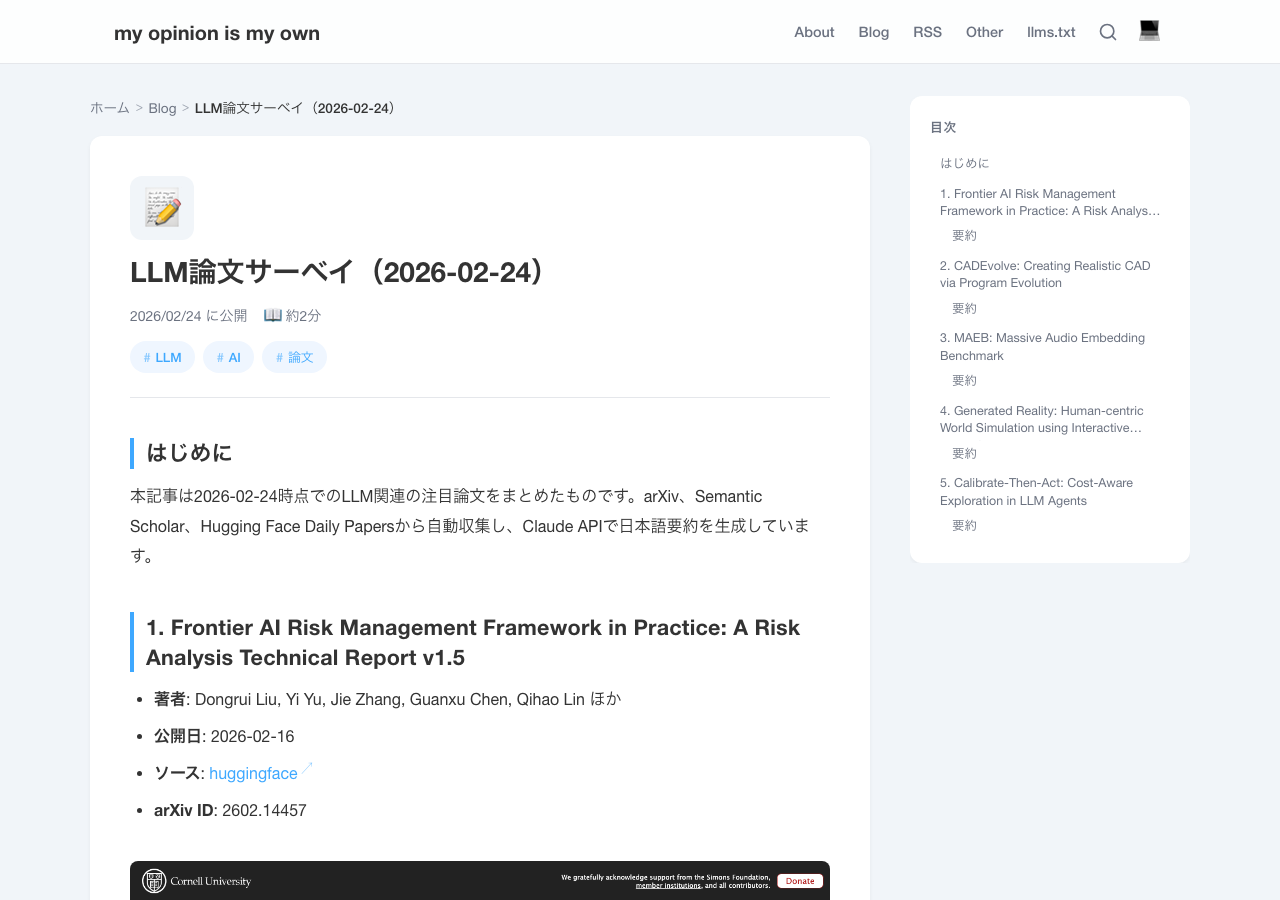
Sample Generated Article
Here is a screenshot of an article actually generated by the pipeline.
Architecture Overview
The overall processing flow of the pipeline is as follows:
[launchd: daily at 7:00]
       |
       v
[run_pipeline.sh]
       |
       v
[pipeline.py]
  |
  |-- 1. Load state file (state.py)
  |-- 2. Paper collection (fetchers.py)
  |       |-- arXiv API
  |       |-- Semantic Scholar API
  |       |-- HuggingFace Daily Papers API
  |       |-- Deduplication + popularity sort
  |-- 3. Exclude already processed papers
  |-- 4. Generate Japanese summaries (summarizer.py) ... claude -p
  |-- 5. Capture screenshots (screenshot.py) ... Playwright
  |-- 6. Generate Hugo articles (publisher.py)
  |-- 7. Save state file
  |-- 8. git commit → hugo build → git push
  |-- 9. Slack notification (notifier.py) ... claude -p + Slack MCP
Directory Structure
scripts/llm_papers/
├── config.py               # Centralized configuration values
├── fetchers.py             # Paper retrieval from 3 sources
├── summarizer.py           # Summary generation via Claude CLI
├── screenshot.py           # Screenshots via Playwright
├── publisher.py            # Hugo article generation
├── notifier.py             # Slack notification
├── state.py                # Idempotency state management
├── pipeline.py             # Main orchestrator
├── run_pipeline.sh         # Shell wrapper called by launchd
├── requirements.txt        # Python dependencies
├── processed_papers.json   # Record of processed paper IDs
├── pipeline.log            # Application log
└── venv/                   # Python virtual environment
Paper Collection (fetchers.py)
Papers are collected from 3 sources and converted into a unified Paper dataclass.
Data Model
@dataclass
class Paper:
    paper_id: str
    title: str
    authors: list[str]
    abstract: str
    published: str          # ISO date string
    url: str
    source: str             # "arxiv", "semantic_scholar", "huggingface"
    arxiv_id: str | None = None
    doi: str | None = None
    categories: list[str] = field(default_factory=list)
    popularity_score: float = 0.0  # Popularity score
Retrieval Strategy for Each Source
| Source | API | Time Range | Popularity Metric | Max Retrieval |
|---|---|---|---|---|
| arXiv | arxiv Python library | Latest 50 | Supplemented via S2 Batch API | 50 |
| Semantic Scholar | Graph API v1 | Past 3 days | citationCount | 20/keyword |
| HuggingFace | Daily Papers API | Current day | upvotes | All |
arXiv
Filters LLM-related keywords from cs.CL (Computational Linguistics) and cs.AI (Artificial Intelligence) categories.
cat_query = " OR ".join(f"cat:{cat}" for cat in ["cs.CL", "cs.AI"])
keyword_query = " OR ".join(f'abs:"{kw}"' for kw in ARXIV_KEYWORDS[:5])
query = f"({cat_query}) AND ({keyword_query})"
Due to strict rate limiting of the arXiv API, delay_seconds=5.0 and num_retries=5 are set.
Semantic Scholar
Uses the /paper/search endpoint of Graph API v1, filtering to the past 3 days with the publicationDateOrYear parameter. The citationCount field is used directly as the popularity score.
HuggingFace Daily Papers
Retrieves curated papers for the current day from https://huggingface.co/api/daily_papers. Since HuggingFace includes non-LLM papers, keyword filtering is applied.
LLM_FILTER_KEYWORDS = [
    "language model", "LLM", "transformer", "GPT", "BERT",
    "instruction tuning", "RLHF", "prompt", "chain of thought",
    "retrieval augmented", "RAG", "fine-tuning", "alignment",
    "reasoning", "tokeniz", "attention mechanism", ...
]

def _is_llm_related(title: str, abstract: str) -> bool:
    text = (title + " " + abstract).lower()
    return any(kw.lower() in text for kw in LLM_FILTER_KEYWORDS)
The upvotes field is used as the popularity score.
Popularity-Based Sorting
Papers retrieved from arXiv lack popularity information, so citation counts are supplemented using the Semantic Scholar Batch API.
def _enrich_popularity_from_s2(papers: list[Paper]) -> None:
    papers_to_enrich = [p for p in papers if p.popularity_score < 0.1 and p.arxiv_id]
    arxiv_ids = [f"ArXiv:{p.arxiv_id}" for p in papers_to_enrich]

    resp = requests.post(
        "https://api.semanticscholar.org/graph/v1/paper/batch",
        json={"ids": arxiv_ids[:500]},
        params={"fields": "citationCount,externalIds"},
    )
    # Reflect results in popularity_score
Finally, papers are sorted in descending order by (popularity_score, published) tuple, prioritizing popular and recent papers.
Deduplication
Duplicates from multiple sources are handled in two stages: ID-based deduplication (arXiv sources preferred) and normalized title-based deduplication.
Japanese Summary Generation (summarizer.py)
Instead of the Anthropic SDK, summaries are generated by directly calling the Claude Code CLI (claude -p). This eliminates the need for ANTHROPIC_API_KEY management.
def generate_summary(paper: Paper) -> str:
    prompt = (
        f"Please summarize the following paper's Abstract in Japanese. "
        f"The summary should be 3-5 sentences, accurately conveying the technical content. "
        f"Output only the summary text, no preamble or explanation.\n\n"
        f"Title: {paper.title}\n"
        f"Abstract:\n{paper.abstract}"
    )

    result = subprocess.run(
        ["claude", "-p", prompt],
        capture_output=True, text=True, timeout=120,
        env=_get_claude_env(),
    )
Removing CLAUDECODE Environment Variable
When the pipeline is executed from within a Claude Code session, launching nested Claude CLIs is rejected. To work around this, the CLAUDECODE environment variable is removed before running subprocesses.
def _get_claude_env() -> dict:
    env = os.environ.copy()
    env.pop("CLAUDECODE", None)
    return env
Slack Notification (notifier.py)
After processing is complete, a paper summary is posted to Slack’s #notify channel. Instead of calling the Slack API directly, the approach is to call the Slack MCP tool via Claude Code CLI.
def notify_slack(papers, summaries, date) -> bool:
    message = _format_slack_message(papers, summaries, date, blog_url)

    prompt = (
        f"Please post the following message to the Slack notify channel (ID: {SLACK_CHANNEL_ID}) "
        f"using the mcp__slack__slack_post_message tool. "
        f"Post the message content as-is, no other output needed.\n\n"
        f"Message:\n{message}"
    )

    result = subprocess.run(
        ["claude", "-p", "--allowedTools", "mcp__slack__slack_post_message"],
        input=prompt,
        capture_output=True, text=True, timeout=60,
        env=_get_claude_env(),
    )
--allowedTools is used to allow only the Slack posting tool, preventing unintended tool calls.
Ensuring Idempotency (state.py)
Processed paper IDs are managed in processed_papers.json to prevent duplicate processing of the same paper.
{
  "processed_ids": {
    "arxiv:2602.10693": {
      "title": "VESPO: Variational Sequence-Level Soft Policy Optimization...",
      "processed_at": "2026-02-23T21:52:36.202101"
    },
    "arxiv:2602.08354": {
      "title": "Does Your Reasoning Model Implicitly Know When to Stop Thinking?",
      "processed_at": "2026-02-23T21:52:36.202114"
    }
  },
  "last_run": "2026-02-24T09:16:33.952783"
}
In each pipeline run, processed IDs are excluded from the retrieved paper list, and the top N papers (default 5) are selected.
new_papers = [p for p in all_papers if not is_processed(state, p.paper_id)]
featured_papers = new_papers[:TOP_N_PAPERS]
Hugo Article Generation (publisher.py)
Selected papers are output as Markdown with YAML front matter. Each paper includes a Japanese summary and a collapsible original Abstract.
Generated article structure:
---
title: "LLM Papers Survey (2026-02-24)"
tags: ["LLM", "AI", "論文"]
url: llm-papers-2026-02-24
date: 2026-02-24
---

## 1. Paper Title
- **Authors**: ...
- **Source**: [huggingface](https://arxiv.org/abs/...)

### Summary
(Japanese summary generated by Claude CLI)

{{< details "Original Abstract" >}}
(English original)
{{< /details >}}
Automatic Deployment
After article generation, the following git operations are automatically executed:
def git_commit_and_push(post_dir: Path) -> None:
    subprocess.run(["git", "add", str(post_dir)], cwd=PROJECT_ROOT)
    subprocess.run(["git", "commit", "-m", f"Add LLM papers survey ({date})"], cwd=PROJECT_ROOT)
    subprocess.run(["hugo", "--config", "hugo.toml", "-d", "docs"], cwd=PROJECT_ROOT)
    subprocess.run(["git", "add", "docs/"], cwd=PROJECT_ROOT)
    subprocess.run(["git", "commit", "-m", "Build website"], cwd=PROJECT_ROOT)
    subprocess.run(["git", "push", "origin", "main"], cwd=PROJECT_ROOT)
Scheduled Execution (launchd)
Using macOS launchd, the pipeline runs automatically every morning at 7:00.
<!-- ~/Library/LaunchAgents/com.zatoima.llm-papers-pipeline.plist -->
<dict>
    <key>Label</key>
    <string>com.zatoima.llm-papers-pipeline</string>
    <key>ProgramArguments</key>
    <array>
        <string>/bin/bash</string>
        <string>/.../scripts/llm_papers/run_pipeline.sh</string>
    </array>
    <key>StartCalendarInterval</key>
    <dict>
        <key>Hour</key>
        <integer>7</integer>
        <key>Minute</key>
        <integer>0</integer>
    </dict>
</dict>
In the shell wrapper (run_pipeline.sh), the Python binary in the venv is specified directly rather than using source activate. This is because source activate can fail in the launchd environment.
# Direct path instead of activate (for launchd compatibility)
./venv/bin/python3 pipeline.py --verbose
Error Handling
Each API call includes a retry mechanism with exponential backoff.
def _retry_request(func, *args, **kwargs):
    for attempt in range(MAX_RETRIES):
        try:
            return func(*args, **kwargs)
        except Exception as e:
            if attempt < MAX_RETRIES - 1:
                wait = RETRY_DELAY * (2 ** attempt)  # 2s, 4s, 8s
                time.sleep(wait)
            else:
                raise
Even if retrieval from some sources fails, processing continues with other sources, so the entire pipeline doesn’t stop. When summary generation fails, the first 300 characters of the Abstract are used as fallback text.
CLI Options
The following options are available for development and debugging:
| Option | Description |
|---|---|
--verbose |
DEBUG level log output |
--skip-screenshots |
Skip screenshot capture |
--skip-push |
Skip git commit/push |
--dry-run |
Only display papers to be processed |
--max-papers N |
Specify number of papers to retrieve |
Source Code
The source code for this pipeline is published on GitHub.
https://github.com/zatoima/llm-papers-pipeline
Summary
Key features of this pipeline:
- 3-source collection: Automatic collection from arXiv, Semantic Scholar, and HuggingFace Daily Papers
- Popularity-based selection: Automatic pickup of notable papers via upvotes and citation count prioritization
- Claude Code CLI utilization: Summary generation without API key management and Slack MCP-based notifications
- Idempotency: Duplicate processing prevention via state management with
processed_papers.json - Automatic deployment: End-to-end execution from Hugo build → GitHub Pages publishing → Slack notification
- Scheduled execution: Unattended operation at 7:00 daily via macOS launchd